
DillaDev Notes
July 3, 2026 | Gary Dillaman | 3 min read
Why Your Apple Watch Sleep Score Isn't Enough (And What You Should Track Instead)
The Apple Watch provides excellent sleep data, but a single nightly score doesn't tell the whole story. Learn why trends, sleep debt, recovery, and consistency matter more, and how RepliRest helps you understand your sleep.
Quick Take
A nightly score is a signal, not the story.
If you want better sleep outcomes, track patterns over weeks: consistency, cumulative debt, deep sleep direction, and recovery trajectory.
Introduction
Most people check one sleep number and still feel confused.
Apple Watch users often wake up, check a score, and move on. Even with good data, they are left wondering whether sleep is actually improving.
The routine is familiar. You wake up, unlock your phone, glance at your sleep score, and mentally decide if last night was good or bad. If the number is high, you feel reassured. If it is low, you may feel behind before the day even starts. The problem is that a single score, by itself, rarely explains what changed, why it changed, or what to do next.
Apple deserves credit here: the Apple Watch provides excellent sleep data for everyday users. It captures sleep timing, sleep stage estimates, heart metrics, breathing context, and trend direction in a way that used to require specialized tools. The challenge is not that the watch fails to measure enough. The challenge is interpretation, especially when daily life is messy and sleep is affected by routines, stress, travel, workload, and habits.
Think of your nightly score as a weather snapshot. It tells you what conditions looked like in one moment. But just like weather, sleep is better understood as a pattern over time. A single storm does not define a season. A single sunny day does not erase a rainy month. If your goal is better energy, better performance, and better resilience, the bigger question is not, "What happened last night?" The bigger question is, "What direction are things heading?"
This article walks through what Apple Watch actually measures, why one-night thinking is limiting, how invisible sleep debt builds, why consistency beats occasional perfect nights, and which trends are more useful than a daily score. If you use RepliRest, you will also see how it complements Apple Health data by helping you connect nightly outcomes to long-term patterns without replacing the Apple ecosystem.
Apple Health Data
What does the Apple Watch actually measure?
Apple Watch sleep tracking is valuable because it captures multiple layers of context, not just total sleep time. That matters because sleep quality is multidimensional. Two nights with the same duration can feel very different depending on sleep stages, interruptions, stress load, and bedtime timing.
The Apple Watch and Apple Health ecosystem can help you monitor:
Time asleep and time in bed
Total sleep duration and total time spent in bed are related but not identical. Seeing both helps identify nights where you were in bed long enough but slept less efficiently.
Sleep stages
REM, Core, and Deep sleep estimates can reveal distribution patterns, not just quantity. A stable stage profile over time can matter more than one unusually high or low stage night.
Awake periods and heart signals
Night awakenings plus resting heart and related metrics can give clues about stress load, alcohol effects, illness onset, or late routine disruptions.
Trend direction
Weekly and monthly movement tells you whether recovery behavior is improving, stagnating, or drifting backward even when single-day scores look acceptable.
You may also see respiratory rate trends, heart rate variation patterns (where available), and broader readiness signals through Apple Health integrations. These metrics do not provide diagnosis, but they can support better self-awareness and routine adjustments.
The key idea is this: Apple Watch gives you a rich signal set. If progress still feels unclear, it is usually because the data is being read one morning at a time instead of as a connected trend. Once you shift to trend-based interpretation, the same data becomes dramatically more useful.
Trend Thinking
One night does not define your sleep.
A single bad night can feel dramatic, especially when you wake up tired and the score confirms it. But one data point cannot tell you whether your sleep system is improving. It can only tell you what happened in one context on one night.
Below is a simple comparison. Notice how nightly outcomes swing, even when the weekly direction might still be positive.
| Night | Sleep Duration | Sleep Score | Context |
|---|---|---|---|
| Monday | 7h 58m | 84 | Normal routine |
| Tuesday | 6h 12m | 68 | Late work + screens |
| Wednesday | 8h 11m | 86 | Earlier bedtime |
| Thursday | 7h 02m | 74 | Evening caffeine |
| Friday | 5h 49m | 63 | Travel day |
| Saturday | 9h 12m | 89 | Catch-up sleep |
| Sunday | 7h 35m | 81 | Stable routine |
If you focused only on Friday, you might conclude your sleep is failing. If you focused only on Saturday, you might conclude everything is solved. Both conclusions would be incomplete. Weekly averages, trend slope, and consistency bands are more reliable indicators than any isolated score.
This is especially important for people with variable schedules. Work obligations, kids, deadlines, weather events, and social commitments can all shift sleep from day to day. Progress in real life is usually uneven. Trend thinking protects you from overreacting to normal variance.
There is also a psychological benefit. When you evaluate sleep only one night at a time, motivation swings with the score. A low score can trigger discouragement, and a high score can create false certainty. A trend framework stabilizes motivation because you are assessing direction, not judging your entire process based on one point.
If you coach yourself this way, you make calmer decisions. Instead of making dramatic routine changes after one bad night, you look for repeated signals across a week or more. That reduces noise, improves confidence, and makes your adjustments more strategic.
Cumulative Effect
Sleep debt is invisible.
Sleep debt is the cumulative gap between how much sleep your body likely needs and how much you actually get. You can build this deficit gradually without noticing it in one-night scores. That is why many people feel "off" even when recent scores are not terrible.
A simplified example:
Goal: 8 hours

Monday      -2
Tuesday     -2
Wednesday   -2
Thursday    -2

Total Sleep Debt: 8 Hours
In this scenario, no single night looked catastrophic. But by Thursday, cumulative debt is large enough to affect attention, mood stability, exercise readiness, and decision quality for many people. Individual responses vary, but the pattern is common: small deficits stack.
Debt can also hide behind a "decent" score if the scoring model weighs multiple dimensions. A night may score acceptably while still leaving you short on total sleep relative to your baseline need. That is why tracking weekly debt and recovery direction is so useful.
Importantly, this is not a medical diagnosis tool. It is a behavior and trend-awareness framework. You are not trying to pathologize every variation. You are trying to understand whether your current rhythm is likely helping or hurting your long-term recovery.
Another reason debt is easy to miss is adaptation. People can become accustomed to feeling slightly below baseline and start treating it as normal. If your performance has quietly declined over several weeks, you may not notice the change day to day. A rolling debt metric exposes this drift and helps you see what your body has been trying to tell you.
Behavior Pattern
Consistency beats perfection.
Consider two people over the same week.
Person A: high highs, low lows
Excellent sleep three nights. Poor sleep three nights. Large bedtime drift. Big day-to-day swings in duration and next-day energy.
Person B: steady baseline
Consistent 7.5 hours every night, with relatively stable bedtime and wake timing. No perfect nights, but far fewer disruptions.
In many real-world cases, Person B reports better daytime function over time. Why? Biological systems generally respond well to predictable rhythms. Regularity helps with sleep onset, hormonal timing, alertness patterns, and recovery pacing.
Perfection is fragile. Consistency is sustainable. Chasing one ideal score can lead to all-or-nothing thinking: one bad night feels like failure, and one good night feels like full success. A consistency mindset reframes progress as repeatable behavior, not occasional performance spikes.
You do not need flawless nights to improve. You need enough stable nights to create trend momentum. Even moderate improvements in bedtime regularity can produce better outcomes than dramatic but inconsistent efforts.
Recovery Curve
Recovery takes time.
It is tempting to think one long sleep session can reset everything. If you slept poorly for several nights and then get ten hours, that can absolutely help. But recovery is usually gradual, not instant.
Multiple systems are involved: nervous system load, circadian alignment, metabolic regulation, training fatigue, stress carryover, and cognitive restoration. A single long night may improve symptoms, but it often does not fully restore baseline after repeated short nights.
This matters because people often interpret one rebound night as proof they are back to normal, then resume the same habits that created the debt. Sustainable recovery usually requires several days of better sleep opportunity, stable scheduling, and reduced disruption.
If your recent week includes short nights, the most helpful mindset is not "fix tonight." It is "support recovery this week." That shift encourages practical behavior: regular bedtime, fewer late stimulants, stress downshift routines, and deliberate planning around known disruptions.
This is where patience becomes a performance tool. Many users abandon sleep improvements because they expect immediate, dramatic change. In reality, strong sleep trends are often built through small repeatable wins: thirty minutes earlier in bed on weekdays, one less late stimulant window, one better wind-down routine, one steadier wake time anchor.
Those actions may not transform tomorrow morning's score, but they often reshape your month. Recovery momentum tends to compound when routines are realistic enough to survive busy weeks.
Cause and Effect
Your habits matter more than your score.
Scores summarize outcomes. Habits drive outcomes. If you only track the summary number, you miss most of the leverage.
Habit-sleep relationships are personal and context-dependent. Evidence is strong for some factors and mixed for others, but most users benefit from observing how recurring behaviors correlate with their own trend lines.
Bedtime consistency
Regular sleep and wake windows often improve stability more than occasional long catch-up nights.
Late caffeine
Sensitivity varies widely. Some people tolerate afternoon caffeine; others see measurable sleep disruption from similar timing.
Alcohol timing
Some users report faster sleep onset but poorer sleep structure later in the night. Responses differ, and effects can be subtle at first.
Exercise timing
For many people, daytime training supports sleep. Very late intense sessions may help some and disrupt others depending on adaptation.
Stress and load
Mental load, emotional stress, and unresolved work pressure can increase nighttime arousal and sleep fragmentation.
Travel and screens
Time-zone shifts and bright late-evening light can push sleep timing and reduce perceived sleep quality for many users.
The practical goal is pattern detection, not perfection. If two or three habits repeatedly precede low-quality nights for you, that is actionable. If certain routines consistently align with better recovery, that is also actionable. This turns sleep tracking into learning instead of score chasing.
A useful method is to run short habit experiments for one to two weeks at a time. Keep most variables steady, change one behavior, and review trend movement rather than single-day reactions. For example, shift caffeine cutoff earlier for fourteen days, or maintain a tighter bedtime window for two weeks, then compare consistency and recovery direction against your prior baseline.
Another practical step is to review your worst nights for common triggers rather than isolated blame. Did stress peak on those days? Did screen exposure run later than usual? Was dinner timing inconsistent? These repeated patterns are usually more instructive than any one score because they reveal the levers you can realistically adjust.
Weekly and Monthly Review
Focus on trends instead.
If you only have ten minutes each week to review sleep, spend that time on trend metrics that guide decisions. These are the indicators most likely to show whether your routines are moving in the right direction.
Average bedtime and wake time
Track drift and stability. Smaller swings usually mean better rhythm alignment and easier sleep onset.
Average sleep duration
Daily noise matters less than whether your weekly average is rising, flat, or falling relative to your goal.
Weekly sleep debt
Debt helps explain fatigue that single-night scores miss. Watch the rolling total, not just last night's outcome.
Monthly improvements
Compare month-over-month direction in consistency, stage balance, and recovery quality to measure real progress.
Deep sleep and recovery trends
Do not obsess over one deep-sleep value. Follow trend movement and context over multiple weeks.
Consistency score
A stable baseline often predicts better daytime function than occasional high-scoring outlier nights.
Trend review creates better questions: "What changed this week?" "Which routines helped?" "What should I keep next week?" Those questions naturally produce better decisions than "Was last night good or bad?"
If you like simple workflows, start with a weekly checkpoint at the same time each week. Review only three items: your consistency trend, your rolling debt, and your recovery direction. Then pick one adjustment for the next week. This keeps sleep improvement realistic and sustainable, especially during busy periods.
Over a month, this process creates a visible story of improvement, not just scattered nightly wins and losses. You begin to see which routines are robust under stress, which habits fail during travel weeks, and which adjustments deliver meaningful gains for your own schedule.
Companion Approach
How RepliRest helps
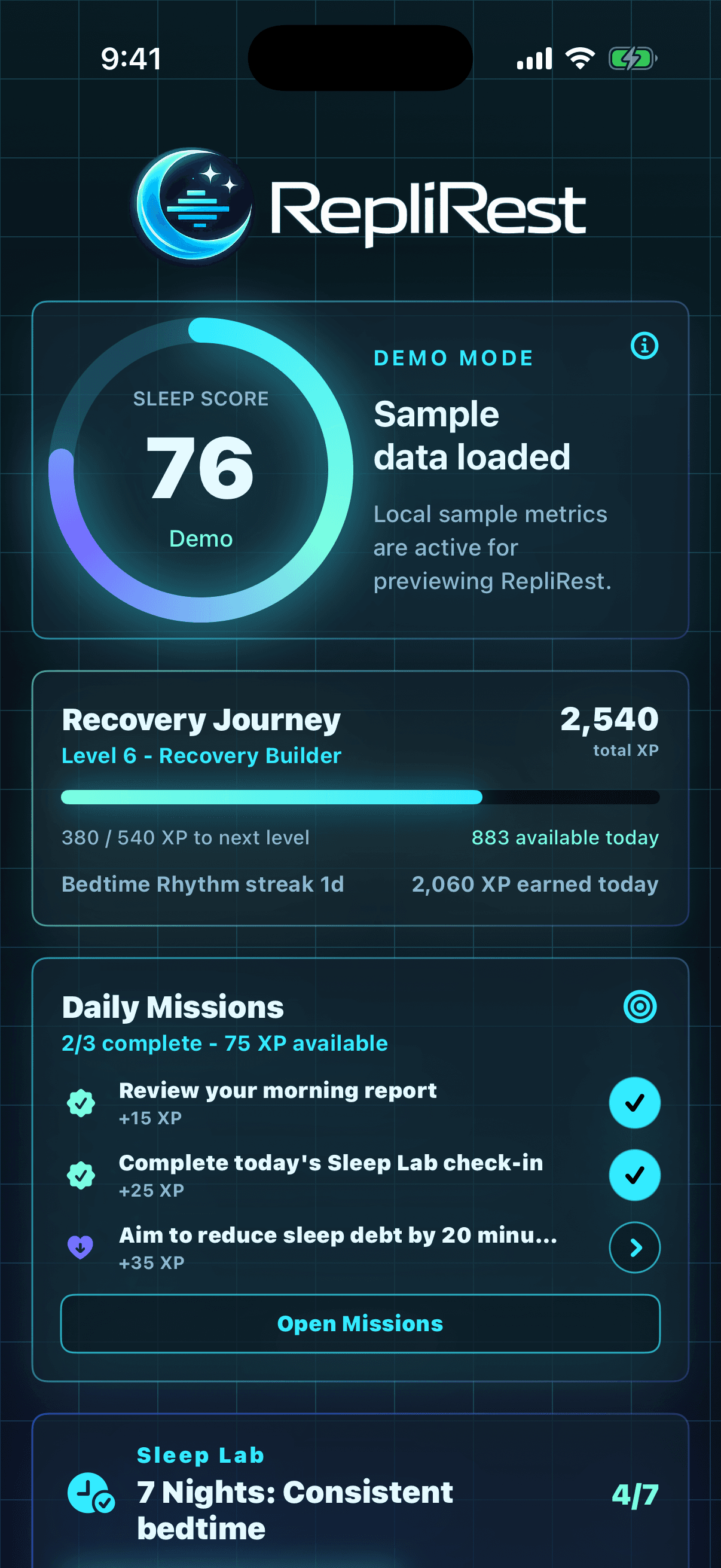
RepliRest is built to complement Apple Health data, not replace it. Apple Watch captures the signal. RepliRest helps organize and interpret that signal in a trend-first way so users can make clearer weekly decisions.
Instead of asking users to chase perfect nightly outcomes, the app emphasizes long-term behavior patterns and recovery direction.
Sleep debt tracking
Monitor cumulative shortfall across the week so hidden deficits are visible before they become obvious fatigue.
Weekly insights
Summaries highlight what shifted, what improved, and what likely deserves focus next.
Monthly trends
Track direction over longer windows, which helps separate normal variance from meaningful improvement.
Recovery visualization
Visual context makes it easier to understand whether your recovery profile is stabilizing or drifting.
Consistency tracking
See how regular your routine is becoming, because repeatable behavior usually matters more than perfect spikes.
Naps, achievements, and milestones
Naps, streaks, achievements, and sleep milestones can reinforce sustainable habits through clear progress markers.
The value is educational even if you never become a power user. A clearer timeline of habits and outcomes helps anyone understand their own patterns better. That is ultimately the point: practical insight, not sleep perfection.
RepliRest is most useful when treated as a reflection tool. You are not trying to win a sleep leaderboard. You are trying to build a sleep system that works in your real life, including imperfect weeks, changing schedules, and normal variability.
Conclusion
Better questions lead to better sleep decisions.
Apple Watch sleep tracking gives you excellent raw visibility into nightly behavior. If you only use that visibility for a single score check, you are using a fraction of what the data can offer.
Sleep improvement is usually cumulative. It comes from identifying which habits move your trend in the right direction, reducing recurring debt, improving consistency, and giving recovery enough time to compound.
Instead of asking 'How did I sleep last night?', start asking 'How has my sleep improved this month?'
If you want a clearer way to monitor those patterns, explore RepliRest as a companion to your Apple Health data.
Better sleep does not require perfect nights. It requires better feedback loops, better pattern awareness, and a system that helps you keep improving even when life is not perfectly controlled.
RepliRest
Track trends, not just one score.
Use your Apple Watch data to understand sleep debt, consistency, and recovery direction over time with RepliRest.
Related Reading